What Coaches Know That Athletes Don't
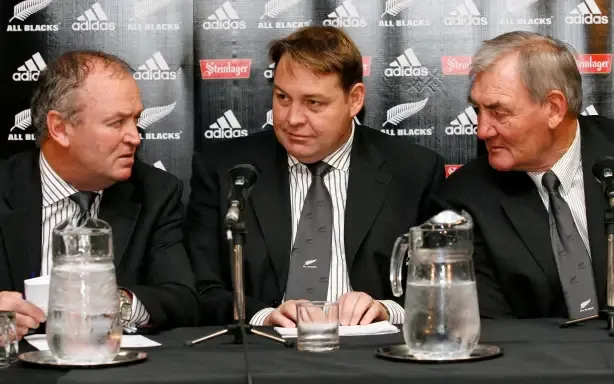
An athlete can tell you what the peak felt like. A coach has to explain how it was built and rebuilt after it broke. Bennett's 21 seasons, Henry's reappointment after 2007, Hansen's exit after 2019 and why the loss is the useful part.
What Coaches Know That Athletes Don't
An athlete can tell you what the peak felt like. A coach has to explain how it was built, held together across a decade, and rebuilt after it broke. That second job is the one your managers actually have. Wayne Bennett, Sir Steve Hansen and Sir Graham Henry between them ran elite teams for the better part of forty years, and what makes them useful to a business audience is not the trophies.
What can a coach tell a business audience that an athlete can't?
How the environment was constructed, and what it cost to maintain. An athlete's material is their own career: the setback, the comeback, the moment. It is genuinely moving and it is one person's experience. A coach's material is a system that had to work across dozens of people, most of whom did not want to hear what they were told, over multiple years.
That is a management subject. Selection decisions and the people they disappoint. Feedback delivered under pressure without breaking someone. Culture that survives a bad season. Succession. Every one of those has a direct equivalent in an organisation, and almost none of them appear in a standard sports keynote.
Wayne Bennett coached the Brisbane Broncos for 21 consecutive seasons, from 1988 to 2008. Twenty-one years in the same job, in a code that sacks coaches for two bad months. Whatever he did to stay employable and effective for that long is a more interesting question than any single grand final.
Why is the loss more useful than the win?
Because the win is a highlight reel and the loss is a case study. All three of these men are defined as much by a failure as by a trophy, and the failures are where the transferable content sits.
Sir Graham Henry took the All Blacks out of the 2007 World Cup at the quarter-final stage, the worst result in the team's history. New Zealand Rugby had never reappointed a losing World Cup coach. They reappointed Henry, along with Steve Hansen and Wayne Smith, and absorbed a savage public backlash for doing it. Four years later the same coaching group won the 2011 World Cup, and Henry finished with 88 wins from 103 Tests.
Think about that as a governance decision rather than a sporting one. A board looked at a public, humiliating failure and concluded the problem was the preparation, not the people. Most organisations do the opposite, because replacing someone is visible action and rebuilding is not.
Sir Steve Hansen has the other version. He holds the best record of any All Blacks coach, 93 wins from 107 Tests at 87 per cent, with four World Rugby Coach of the Year awards, and he won the 2015 World Cup to make New Zealand the first side to go back-to-back. He also lost the 2019 semi-final to England and left immediately afterwards. A speaker who can talk honestly about that, at the end of that record, is worth more to a leadership audience than one who stops the story at the trophy.
What does the All Blacks succession say about your own?
That continuity is a decision, not a default, and that most organisations make it badly. Hansen was an assistant under Henry from 2004 to 2011 before taking over. That handover produced the two most successful coaching tenures in the team's history, back to back.
It also created a problem worth discussing openly. Promoting from within repeatedly can start to look like a closed shop, and there is a real risk that a successor stays permanently wedded to their predecessor's ideas. New Zealand rugby has been arguing about exactly that in the years since.
For an audience of executives thinking about their own leadership pipeline, that is a live question with two credible answers and no comfortable one. It is also considerably more interesting than a session on resilience.
How do you actually hand leadership to the people doing the work?
By giving it away for real, which is harder than it sounds and is the substance of what Henry changed after 2007. The rebuild toward 2011 involved establishing a player leadership group and running what Henry described as dual management, with the coaching staff and senior players jointly responsible. The underlying idea was that players will handle a challenge if it is genuinely their challenge.
Most organisations claim to do this. Very few actually transfer authority, because the moment something goes wrong, it comes straight back up. The interesting content is not the principle, it is the mechanics: which decisions moved, who held them, what happened the first time the group got one wrong, and how the coaching staff resisted taking it back.
This is the single most requested subject at leadership conferences and the one where generic speakers have the least to say. Someone who did it under national scrutiny, having already failed publicly once, has something specific.
For an Australian room, Wayne Bennett carries immediate recognition and a home-code advantage. Hansen and Henry bring something Australian audiences often find easier to hear precisely because it is not their code: the argument lands as method rather than tribal loyalty.
A note on that. Rugby league and rugby union do not carry the same audience in every Australian city or sector, and a Brisbane room and a Perth room will not respond identically. It matters less than you would think, because the material is about management, but it is worth flagging in the brief.
What should you brief them on?
The same things you would brief any speaker on, plus one specific instruction.
Assume no sport knowledge. Half your audience will not follow either code, and a talk that opens with match detail loses them in the first three minutes.
Name the parallel you want drawn. Selection, succession, culture after a restructure, feedback, sustained performance. Pick one. All three of these speakers can go anywhere, which means an unclear brief produces a general talk.
Tell them what has actually happened in your organisation. A leadership rebuild after a failed year is a different session to a room celebrating a strong one.
Ask for the loss. Explicitly request that the session covers the failure and the response, not just the record. It is the part audiences remember and the part most likely to be trimmed if the slot runs short.
Protect the Q&A. Coaches answer questions better than they deliver monologues. Fifteen minutes minimum, and use a moderator who will ask a real one first to break the ice.